

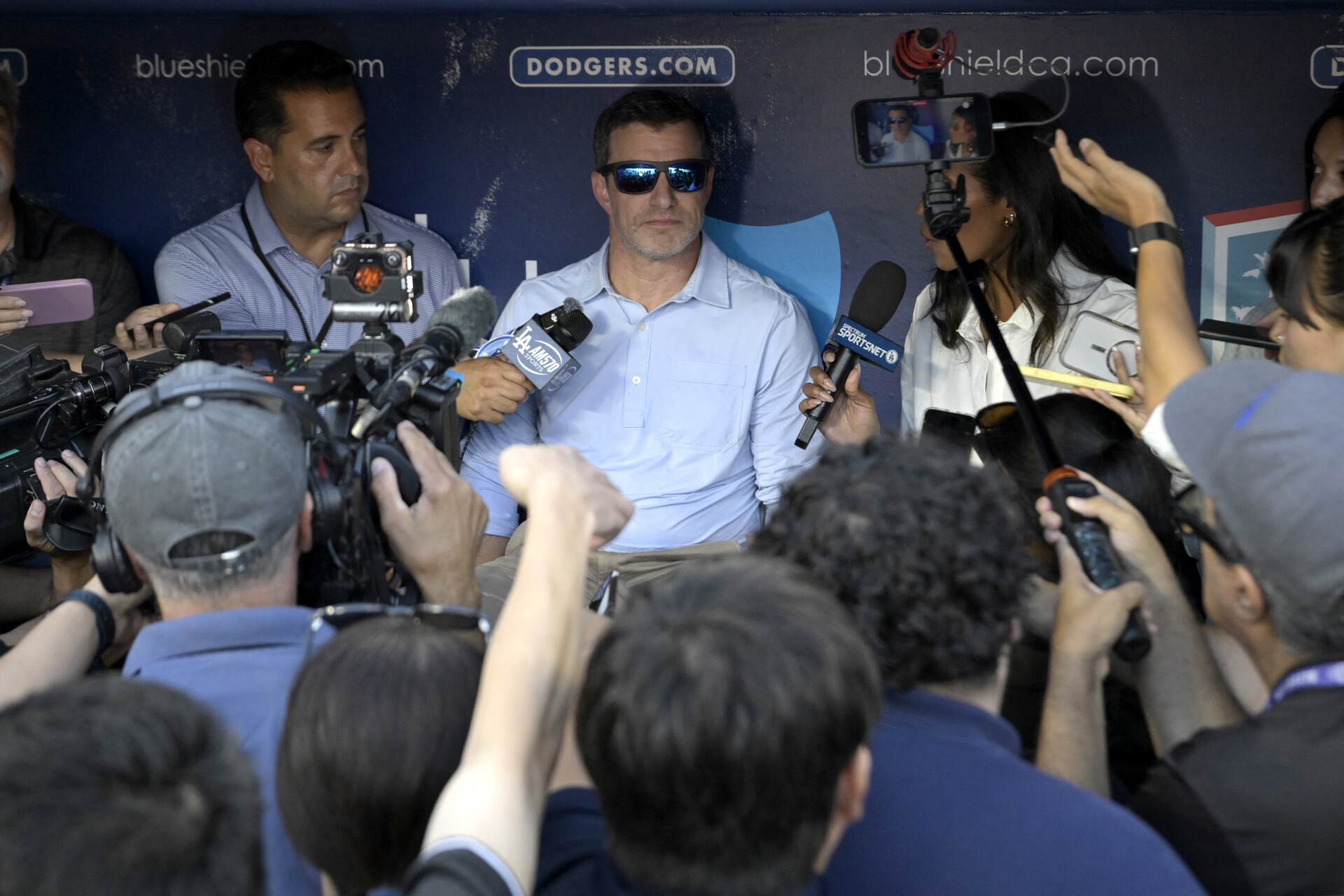
Los Angeles Dodgers president of basketball operations Andrew Friedman was firmly against following the Milwaukee Brewers’ blueprint.
Andrew Friedman speaks out
Ahead of the General Managers’ meetings in Las Vegas, Friedman took the time to talk with Bill Plunkett of the Orange County Register.
Plunkett, with a possible flurry of action coming soon, asked Friedman if there would be any changes in approach to follow the Brewers’ trends.
“No. I think every year there’s a narrative that forms around the team that wins,” Friedman told Plunkett. “They’re a really good team that was playing really good baseball at the right time.
“Obviously, to win a World Series you have to have really good players. So I’ve learned that having really good players is really helpful in winning a World Series.
“I think there are really lazy narratives that are formed when teams win. It’s ‘Oh, you have to do this.’ This year there was a lot of talk about the Brewers making contact. Well, we made more contact than they did in the NLCS.
“People don’t like that when it goes against their argument. It’s never as simple as being able to learn something that you can then directly apply. I think the most important thing is to understand the strengths and weaknesses of your roster and then to lean into the strengths as much as you can. That’s my takeaway.”

Is Friedman right?
Friedman naturally pointed to the ongoing narrative that the Brewers mastered a small-ball, contact-heavy approach the Dodgers could not match.
Since the Dodgers were eliminated, many teams have pointed to their over-reliance on slugging, but Friedman makes a valid point about the amount of contact they generated.
The Dodgers had 95 batted-ball events, which exclude strikeouts, walks, and hit-by-pitches, compared to 85 for the Milwaukee Brewers.
In the end, the Dodgers lost in part because they got out-slugged, with a 2.5% home run-to-fly ball rate compared to 29.2% for the Brewers.
The Dodgers also posted just a .239 BABIP (batting average on balls in play), while Milwaukee’s contact paid off more often with a .329 BABIP.
There are some areas where the Dodgers were flat-out dominated—the Brewers had a 4.2 speed score, higher than LA’s 1.3.
They also got on base more than the Dodgers, with a .347 clip as opposed to the Dodgers’ .270.
The offense for LA was not good enough, nowhere near, in fact, though contact was not the reason for that.
Looking forward, more speed and possibly some youthful bats that complement the Dodgers’ key players could give the team more offensive options.

One Response
Maybe Friedman should focus on baseball and not basketball.